
Meta Advertise Explained for Businesses Considering Meta Ads
Key Facts
What does it mean to advertise on Meta?
Advertising on Meta means running paid campaigns across Facebook and Instagram via Ads Manager. You set an objective — leads, traffic, or conversions — then define an audience, creative, and budget. Meta optimises delivery toward your chosen result.
How much does it cost to advertise on Meta?
There is no fixed price. Costs depend on your objective, audience, and competition in the ad auction. You set a daily or lifetime budget and Meta spends within it. Most advertisers pay per impression or per click.
Is Meta advertising worth it for small businesses?
It can be, when you have a defined audience, a clear offer, and one action you want people to take. Returns are weaker when strategy or post-click experience is unclear. Start with a strong setup and realistic expectations.
Quick Summary
Can you advertise on Meta?
Yes. Businesses can run paid campaigns across Meta platforms, especially Facebook and Instagram, to support goals like awareness, traffic, leads, and conversions.
Why am I getting charged for Meta ads?
Meta ads spend against the budget and campaign setup you choose in Ads Manager. Charges relate to delivering your ads based on the selected objective, audience, placements, and budget.
What does Meta advertising do?
In most business contexts, it means running ads through Meta to reach defined audiences and drive actions. It can support awareness, website visits, lead generation, and sales.
What "meta advertise" usually means
In most business searches, "meta advertise" usually means Meta ads: paid campaigns that run across Meta's platforms, especially Facebook and Instagram. Source material describing Meta ads consistently frames them as a way for businesses to create ads, target specific audiences, and promote products or services. In plain terms, people searching this phrase are usually looking for help with using Meta's ad system for real marketing goals.
Those goals are practical and business-focused. The sources describe Meta ads as useful for building awareness, driving website traffic, generating leads, and supporting sales or other conversions. They also point to campaign objectives, targeting options, placements, creative formats, and performance tracking as core parts of the platform. So when this article uses the phrase "Meta ads," it is referring to that day-to-day advertising use across Facebook and Instagram rather than to a broader theory term.
There is a separate concept called meta-advertising. That term means advertising about advertising, such as an ad promoting another ad or promoting an advertising agency. It is a real definition, but it is not usually the main commercial intent behind a search like "meta advertise." For most readers, the useful interpretation is the simpler one: how a business can advertise through Meta's ad platform.
Why businesses use Meta ads
Businesses use Meta ads because the platform can help them reach large audiences across Facebook and Instagram. The sources describe Meta ads as a way to put customised messages in front of potential customers on both platforms, which makes them useful for growing brand awareness, sending traffic to a website, and driving actions such as leads or sales. For many companies, that broad reach is a practical starting point: one ad system can support visibility across two major social channels.
Another big reason is control. The sources emphasise targeting options and placements, which let advertisers narrow campaigns toward more relevant audiences instead of showing the same message to everyone. They also highlight cost efficiency, so businesses often see Meta as a channel where budgets can be managed carefully while still testing what works. On top of that, Meta supports different creative approaches, including varied ad formats and media, giving teams room to match the ad style to the offer and the audience.
Meta ads are also widely used because they can support different stages of the marketing funnel. Source material points to campaign objectives, funnel use, and measurable performance tracking as core benefits. In practice, that means a business might use Meta ads first to build awareness, then to encourage visits or engagement, and later to focus on conversions. This mix of reach, targeting, creative flexibility, and trackable results is why many businesses treat Meta ads as an ongoing channel rather than a one-off promotion.
- Reach people across Facebook and Instagram from one advertising platform.
- Use targeting options and placements to focus on more relevant audiences.
- Test different creative formats and campaign goals.
- Support awareness, traffic, lead generation, and conversion activity.

How Meta ads actually work
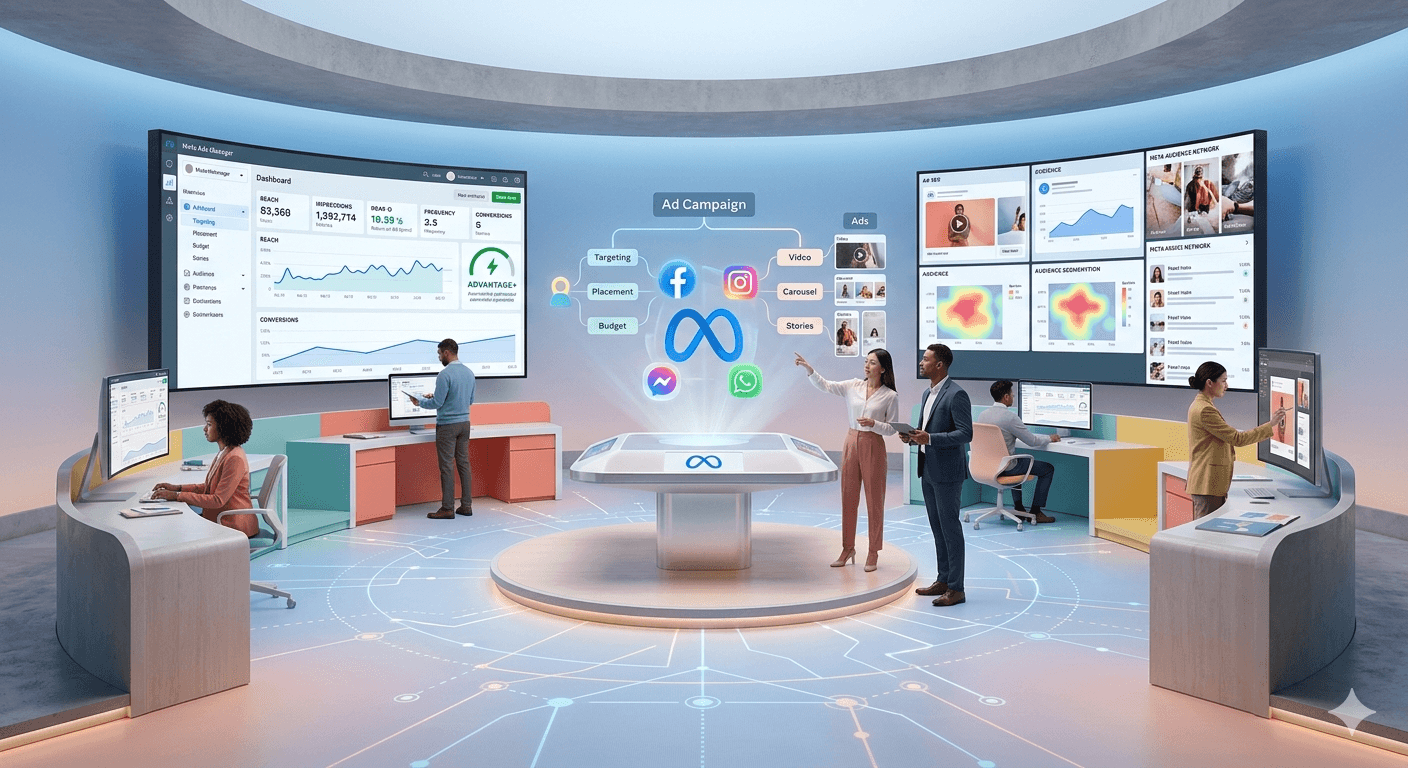
Meta ads work as a system, not as one isolated ad. In Ads Manager, you set a campaign goal first, then build around it with an audience, creative, placements, and budget. That structure matters because Meta uses the goal you choose to guide delivery and optimisation. If you want leads, sales, or traffic, the setup should reflect that outcome instead of treating every ad like a general promotion.
A simple way to think about it: the objective tells Meta what result to look for, the audience defines who should see the ad, and the creative gives people a reason to pay attention or act. Placements decide where the ad appears across Meta properties, and the budget controls how much you are willing to spend to reach and test that setup. When the parts do not align, performance usually becomes harder to judge and improve.
Is Meta advertising right for your business
Meta advertising is often a strong fit for small businesses that want targeted reach and a clear way to measure response. The strongest use cases are usually businesses with a defined audience, a specific offer, and one main action they want people to take. That action might be filling out a lead form, making a purchase, or booking a service. The source material also frames Meta ads as a practical option for small businesses because the platform is built around audience targeting, campaign objectives, and measurable results rather than broad, hard-to-track promotion.
A realistic starting point matters. If your business does not yet know who it wants to reach, what message will matter to that audience, or what conversion step should happen after the click, ad spend alone is unlikely to solve the problem. In simple terms, Meta ads work best when your business is ready to turn attention into a defined next step — not when you are hoping the platform will create that strategy for you.
What to set up before you launch
Before you spend on Meta advertising, lock in the basics first. Small-business guides consistently stress starting with clear campaign intent, not with random settings inside Ads Manager. It also helps to be clear on the offer and message your ad creative needs to carry. When those choices are made early, the campaign setup becomes much easier because each setting has a job.
The next part is making sure the campaign can actually produce useful feedback. Setup and measurement are the difference between learning and wasting spend. If you launch without proper tracking, you will have a weak view of which ads or audiences are driving results. In the same way, if the destination after the click is not ready — whether a landing page, form, or other next step — your campaign can lose momentum even if targeting is solid. A clear path after the ad click is part of campaign setup, not an afterthought.
Confirm the goal, budget, audience, and creative direction. Then confirm that tracking is working and that the post-click experience is ready for real traffic. Meta can give small businesses strong reach and targeting, but the better starting point is disciplined preparation, not speed. A clean launch gives you a far better chance of making early decisions from real data instead of guesswork.
- Choose one main campaign goal before selecting the objective.
- Set a starting budget you can afford to measure and adjust.
- Define the audience and the core offer before building ads.
- Make sure tracking and the destination experience are ready before launch.

References
Frequently asked questions
How do Meta ads work for a business?
Meta ads are built around a campaign objective, audience, creative, placements, and budget. Results depend on how well those parts match the business goal and the post-click experience.
Are Meta ads a good fit for small businesses?
They often are when a business has a clear audience, a clear offer, and one main next step such as a form fill, booking, or purchase. They are less effective when strategy, messaging, or conversion paths are still unclear.
What should be ready before launching Meta ads?
A business should confirm its goal, starting budget, audience, offer, and creative direction before launch. Tracking and the landing page, form, or other destination should also be ready so results can be measured properly.
Is meta advertising the same as meta-advertising?
Not always. This article uses the business meaning most searchers want: advertising through Meta platforms such as Facebook and Instagram, not the separate concept of advertising about advertising.
Next step
Get your setup ready before you spend
If you are considering Meta ads, start with the basics: a clear goal, defined audience, workable budget, and a tracked path after the click. Strong setup makes campaign decisions easier and reduces wasted spend.
Talk to the sysConnector team →About the author

Michelle Low
Founder, sysConnector
Michelle Low is the founder of Omnify X and creator of sysConnector. She enjoys turning messy marketing and CRM setups into simple, connected systems that actually work in real time. Michelle writes about marketing automation, system integrations, customer data, and practical ways to fix broken lead flows—based on what she's building and testing day to day.
More from the blog

How Marketing Agencies Can Capture, Route, and Manage Leads
Learn how marketing agencies can capture, route, and manage leads with clearer intake, faster handoffs, lead scoring, and tighter follow-up processes that reduce lead loss.
Read more →
How to Set Up Your Business for Successful SMS Campaigns
SMS success depends on more than a short message. Learn how clean data, segmentation, automation, and system integration set up campaigns that convert.
Read more →
What Is a Marketing Automation Platform and Why Data Quality Matters
Learn what a marketing automation platform does, why data quality is the make-or-break factor, and what it takes to make automation reliable across your tools.
Read more →